Notes by
hejenemy
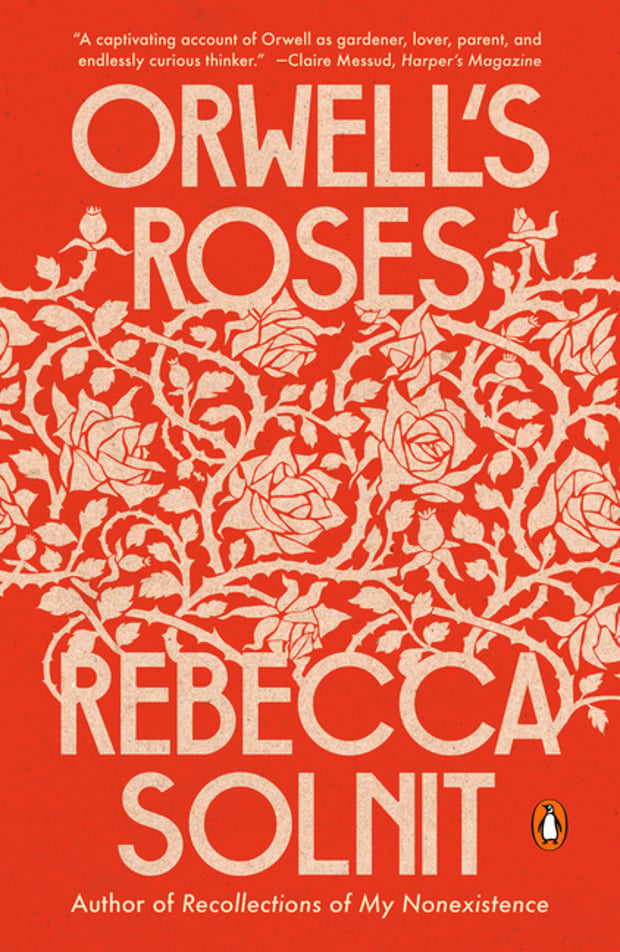
Orwell's Roses
By Rebecca Solnit
This is a remarkably well written pseudo-biography of a writer I'm frankly very unfamiliar with. We're all familiar with Orwell in a passing sense. I read 1984 in high school, if not earlier, and it's one of those books where you may not remember the particulars, but you'll never forget the general theme, partly because it's just become so embedded in our society. Doublespeak, big brother, a boot stomping on a human face, forever. Also read Animal Farm, and recall that being a clever mix of being a children book and oh-shit-definitely-not-a-childrens-book. But I didn't know anything about Orwell himself, which didn't do me any favors here.
I'm not really sure what genre of book this is. The closest I can manage is pseudo-biography. It is, ostensibly, about George Orwell. And it does cover some of the facts of his life; his circumstances, motivations, experiences. But it doesn't attempt to be thorough—the reader is expected to have brought some basics along with them (I didn't), or hopefully be curious enough to look a few things up on the side. Additionally, Solnit travels pretty far from Orwell in places. This is more a collection of essays loosely bunched around Orwell, giving context to his life, actions, and hobbies, and how those things, both literally and figurative, are doing today.
It is a beautiful book. Solnit is exceptional. It's more poetry than prose, though–something to be savored, not hurried. E.g.
The people of 1936 had a confidence so deep it was like an unexcavated strata in their consciousness: that the world was big enough to resilient enough to absorb our harm, that the damage was always going to be local, that whatever we did to the parts would not undermine the whole, that there would always be more. Human beings behaved like a child who believes his mother is immortal no matter what, but the child had grown huge and powerful with powers beyond the human in his tools, machines, and chemical inventions, and he was striking blows that were damaging and changing the system itself.
The writer and actor Peter Coyote once remarked that no one cries over artificial flowers, and there's a particular kind of disappointment when you begin to admire a bouquet or a blossom at a distance and find out closer up that it's fake. The disappointment arises in part from having been deceived, but also from encountering an object that is static, that will never die because it never lived, that didn't form itself out of the earth, and that has a texture coarser, dryer, less inviting to the touch than a mortal flower.
She reminded me what my Black neighbors had taught me earlier that decade, that the yearning to be more rugged, more rustic, more rough, more scruffy, is often a white and a white-collar yearning, and that those who have only recently escaped agricultural work, maybe sharecropping or slavery or migrant labor, who have survived being treated as dirty or backward, are often glad to be polished and elegant. You have to feel securely high to want to go low, urban to yearn for the rural, smooth to desire roughness, anxious about artificiality to seek this version of authenticity. And if you see the countryside as a place of rest and respite you're probably not a farmworker.
By then end, I'm left somewhat in awe. Somehow Solnit wrote a book ostensibly about Orwell, but that makes you yearn to be more alive, and participatory, and aware.
Also, I mean, I should probably read some more Orwell.
320 pages
Published Oct 17, 2022 by Penguin Books
Biography & Autobiography - Literary Figures
Nature - General
Literary Criticism - Subjects & Themes - Nature